
Our assessments.
Defining the starting point.
An accurate evaluation of current skills and competencies is the starting point of all our developmental programs.
We use globally recognised assessments, grounded in years of academic research and scientifically validated. Far more than a diagnostic tool, each one offers a comprehensive report with guidelines to set SMART and meaningful goals and a mapping tool to lay out strategies for development and a powerful action plan.
- Our certified consultants offer a rigorous, confidential and personalised debrief.
- Lasting change is the result of a transformational learning journey; personal motivation and a learning mindset are of course key to success.
Our tools
Power 21 offers a range of assessment tools, selected to meet the client’s needs. Several tools offer not only a self-assessment but also a 360° evaluation.
-

DISC
Identifies behavioural style through 4 profiles: Dominance, Influence, Steadiness, Conscientiousness.
Instantly understand how to work better with anyone, adapting your communication to build smoother, faster collaboration.
-

SDI
Reveals the underlying motives that drive behaviour, in relationships and under pressure.
Defuse tension by understanding what truly drives people, turning disagreement into constructive dialogue.
-

EQ-i 2.0
Measures emotional intelligence: 5 composites, 15 subscales, available as an individual, 360° or group report.
In organisations, a high EQ translates into well-being, healthy relationships, better decisions and stronger performance.
The 5 EQ-i reports -

MBTI
Explores 16 personality types built on 4 natural preferences.
Collaborate more smoothly by understanding our differences, and make the most of diverse profiles within a team.
-

Process Com
Decodes communication styles and psychological needs, to help people understand one another better.
Finally get through to people, whoever they are, by adapting your message to how they prefer to communicate.
“Let’s not forget that the small emotions are the great captains of our lives, and that these we obey without knowing it.”
Emotions are what drive us; they are at the heart of all human interactions and decisions.
We integrate emotions in all our programs; as distributors of the EQ-i, we certify doctors, psychologists, counsellors, consultants and coaches to use the different EQ-i tools according to their clients’ needs.
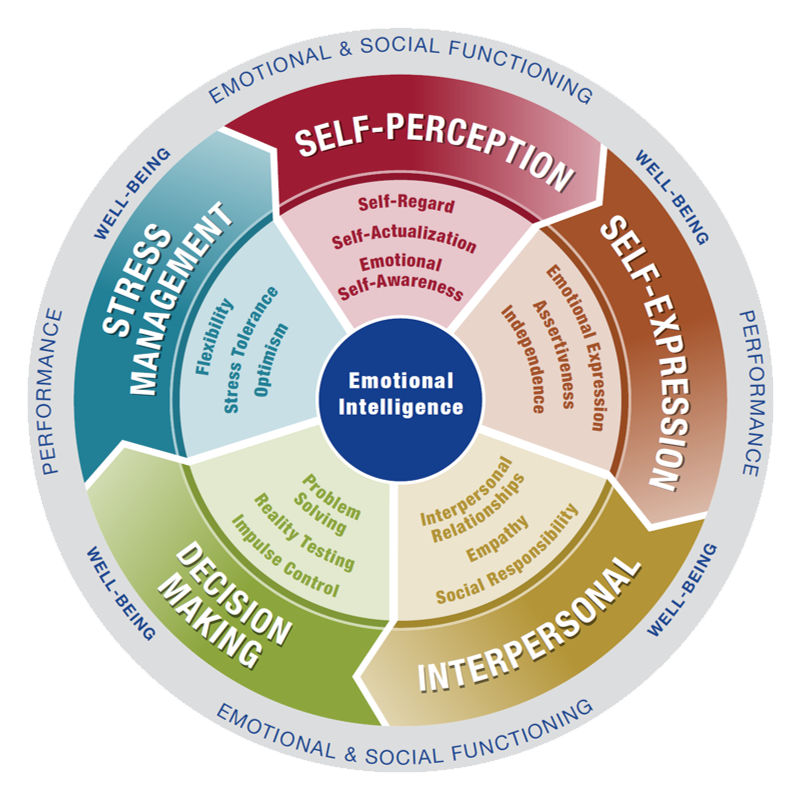
EQ-i 2.0: a closer look at the 5 reports
-
Workplace Report
Designed for use in a wide variety of coaching and development situations and work settings. It focuses on the impact of emotional intelligence at work and offers suggestions for working more effectively with colleagues, supervisors and clients. Both a coach and client version are generated.
-
Leadership Report
Examines EQ-i 2.0 results through four key dimensions of leadership: Authenticity, Coaching, Insight and Innovation. The leadership report contains insights on the leadership and organizational implications of your client’s results, information about which skills are most likely to be leadership derailers, as well as development strategies aimed to help your client reach their true leadership potential.
-
EQ 360°
Allows leaders to receive feedback from peers, managers, direct reports and others on how to leverage their emotional intelligence. The visuals highlight areas of alignment and misalignment between the respondents.
-
Group Report
This report aggregates individual EQ-i 2.0 results to provide a team- or organisation-level reading. It highlights collective strengths and shared areas for improvement in emotional intelligence. It helps identify the dynamics that either support, or hinder, group cohesion and performance. Individual results remain confidential; only the collective reading is shared. An excellent starting point for a team offsite or a collective development plan.
-
Complementary to the EQ-i
CSI 2 (Change Style Indicator® – 2nd Edition)
This tool, complementary to the EQ-i, measures how each person naturally approaches change, on a spectrum from “gradual” to “radical.” It helps explain why some people naturally resist a transformation while others drive it forward instinctively. Especially useful during organisational transformation, mergers or restructuring. Like the EQ-i, it concludes with an individual or group debrief.
Frequently asked questions
How do you measure emotional intelligence?
With a scientifically validated emotional intelligence test such as the EQ-i 2.0: a self-assessment questionnaire that gives an overall score and a detailed profile across 15 emotional skills. To go further, the EQ 360° compares this view with feedback from colleagues, managers and direct reports. Results are shared in a debrief with a certified consultant, to turn them into a concrete development plan. For a first indication, you can take the free emotional quotient test on eqLab21.
What is the EQ-i 2.0?
The EQ-i 2.0 is one of the most widely used emotional intelligence assessments in the world, based on the work of psychologist Reuven Bar-On. It measures 5 composites (self-perception, self-expression, interpersonal, decision-making, stress management) and 15 subscales. It is available as a standard report, Leadership report, 360° and Group report. In organisations, a high emotional quotient translates into well-being, healthier relationships, better decisions and higher performance.
DISC or MBTI: which assessment should you choose?
It depends on your goal. DISC describes observable behavioural style through 4 profiles (Dominance, Influence, Steadiness, Conscientiousness): simple and quick to grasp, it is ideal for improving everyday communication. MBTI explores 16 personality types based on 4 natural preferences: more in-depth, it helps a team understand how differently its members work. Our consultants will recommend the most suitable tool, possibly alongside SDI, Process Communication (Process Com) or the EQ-i 2.0.
What is a 360° assessment?
A 360° assessment compares a person’s self-assessment with feedback from their working environment: peers, managers, direct reports and, if needed, other stakeholders. The gaps between how you see yourself and how others see you are often the most revealing. Several of our tools are available in a 360° version, including the EQ 360°, which focuses on emotional intelligence.
Are assessment results debriefed?
Yes. Every assessment comes with a rigorous, confidential and personalised debrief led by a certified consultant. Beyond the diagnosis, the report and debrief are used to set SMART goals and build an action plan. The assessment thus becomes the starting point of a development programme, not an end in itself.
How do you get certified in the EQ-i 2.0?
As EQ-i distributors, we certify doctors, psychologists, counsellors, consultants and coaches to use the EQ-i 2.0 and EQ 360° tools. Certification sessions are presented on eqLab21, our dedicated emotional intelligence website, where you can also take a free emotional quotient test.
Knowing yourself isn’t a destination, it’s a starting point.
Each tool, each report, each debrief has just one purpose: to give you the keys to your own way of functioning, so you can act with greater clarity, ease and impact.